





Tu peux découvrir ici le sujet complet de LV1 (LVA) Anglais ELVi 2024, l’une des épreuves incontournables du concours BCE. Cette épreuve compte pour la majorité des écoles, avec un coefficient plus ou moins important selon les programmes. Avec la réforme du concours, cette épreuve avait fait peau neuve cette année-là, ce qui en faisait un sujet particulièrement suivi par les candidats.
Rejoins nous en live tous les soirs de concours à 18h30 dans notre live inside concours BCE pour un débrief des épreuves de la journée.
Sujet de LV1 (LVA) anglais ELVi 2024
La thématique : Big Pharma and the American Dream.
Le dossier thématique est composé de 5 documents :
- Document 1 – “We should all support Biden’s war on Big Pharma,” Nick Deaden, Al Jazeera, September 15, 2023 (724 mots en anglais)
- Document 2 – “Oxford University dumps Sackler name from buildings after investigation,” Antonia Cundy, Financial Times, May 16, 2023 (584 mots en anglais)
- Document 3 – « Opioïdes, ou le rêve américain devenu cauchemar » Le Figaro, 23 janvier 2023, 21 (359 mots en français, dont 210 a traduire en anglais)
- Document 4 – Image 1, Graphique : National Center for Health statistics, December 2021
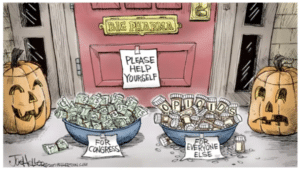
- Document 5 – Image 2, Image : Political cartoon, October 2021
Document 1 LV1 anglais: “We should all support Biden’s war on big Pharma“, Nick Dearden, Al
Jazeera, September 15, 2023 “This time, we beat Big Pharma”, United States President Joe Biden tweeted, after finally giving his government the power to negotiate the price of 10 prescription drugs, including medicines used to treat diabetes, blood cancer and kidney disease. Through these negotiations, it’s expected that millions of Americans will save a small fortune, as the price of drugs provided through the government’s national insurance programme tumble. The pharmaceutical giants are furious. For decades they have been able to charge Americans with public insurance whatever the market will bear for their products. Big Pharma, as these giants are known by their detractors, has now launched multiple legal actions to protect its monopoly power. By European standards, Biden’s actions are moderate. Most countries negotiate the price of drugs purchased by public health systems. While drug prices are still high across Europe, putting severe strain on overburdened health systems, they are a fraction of the price paid by Americans. What makes Biden’s action so significant is precisely that, up to now, Big Pharma has always had the upper hand in the US, using its power to extract whatever profits it likes from the American public. Despite the unpopularity of the industry, only a few brave politicians would stand up to it. What’s changed? First, it’s difficult to overstate the impact of the so-called “opioid crisis” on American society. Hundreds of thousands of Americans have died from opioid overdoses. The real scandal is that the major contributor to this epidemic was a drug company called Purdue Pharma, which spent years pushing an opioid called OxyContin on patients. The drug is so strong and addictive that it shouldn’t be prescribed for any but the most serious, end-of-life, pain. But Purdue spent a fortune cajoling doctors into prescribing the drug for even moderate pain, pretending there was little chance of getting hooked. The levels of addiction and death that followed hollowed out whole towns, as can be seen in the recent dramatisation by Netflix, Painkiller. So the opioid crisis has created mass hostility to the pharma industry. But there’s something deeper going on too, a realisation that these corporations, which we assume are inventing the life-saving medicines of the future, are actually seriously failing in that task. A big wake-up moment was the COVID-19 pandemic. In the run-up to the pandemic, Big Pharma had little interest in researching pathogens that might cause a major epidemic, or indeed in researching vaccines full stop. They simply didn’t represent the sort of jackpot that, say, a new cancer drug could produce. The research that had been done into coronaviruses was carried out with public money. Once the pandemic struck, that public funding was multiplied many times over: Big Pharma was handed billions of dollars to bring vaccines to us as fast as possible. But then, the intellectual property was privatised. Big Pharma owned vaccines created using public money, and got to decide who produced them, at what price, and who got to buy them. Corporate executives, employed to maximise their shareholder returns were in charge of who lived and who died. The Biden administration was horrified when Moderna’s vaccine – almost entirely paid for by the public purse – was making Moderna’s CEO into a multibillionaire, while the US government seemingly had little power to get the vaccine know-how shared and produced more widely. Moderna seemed more interested in legal action to shore up its control of this technology – even going as far as refusing to recognise three government scientists as co-inventors on some of its patents. Pfizer’s vaccine did involve some private funds but was still made with vast sums of public money. Imagine the horror of the US administration when Pfizer tried to charge the government an eye-popping $100 a dose – on a vaccine that seems to have cost somewhere between $0.95 and $4 to produce. One former official accused them of “war profiteering” while another complained, “It’s not even their vaccine.” COVID-19 was not a one-off. Almost all medicines receive substantial public funding. Meanwhile, the folks we think create medicines – Big Pharma – actually invent very few new drugs. Rather, these corporations behave like hedge funds – buying up the monopoly rights to produce medicines which others have made. They then aggressively squeeze everything they can out of this intellectual property – even if it means the vast majority of humanity has no access to medicines. (…)
Document 2 LV1 anglais: “Oxford university drops Sackler name from buildings after investigation”,
Antonia Cundy, Financial Times, May 16, 2023 Oxford university ended its relationship with the Sacklers on Monday after a Financial Times investigation into its continued ties with the wealthy family led academics and students to call for sweeping reforms. The decision to cut social ties and remove the Sackler name from buildings, spaces and staff positions comes at the end of a review instigated by new vice-chancellor Irene Tracey, a professor of anaesthetic neuroscience. Most other prominent arts and academic institutions severed relationships with the billionaire owners of Purdue Pharma between 2019 and 2022, after public outcry over their role in the deadly US opioids crisis, which is estimated to have claimed more than half a million lives. For years, Purdue aggressively marketed OxyContin, its prescription painkiller, downplaying its addictive qualities while netting tens of billions of dollars in revenue. Institutions such as the Louvre Museum in Paris and the National Portrait Gallery in London turned down donations or removed the Sackler name from buildings in 2019. London’s Victoria and Albert Museum, the British Museum, the National Gallery and the Tate gallery group did so in 2022. Oxford came under pressure for bucking this trend when the FT revealed it had continued to court the Sacklers over the past two years, extending exclusive event invitations and accepting donations even as members of the family who own Purdue negotiated a multibillion-dollar bankruptcy settlement over their role in the epidemic. When asked by the FT whether social ties had been included in the review’s outcomes, not detailed in Monday’s public announcement, the university confirmed that “the Sackler Family has agreed to forego its membership of the Chancellor’s Court of Benefactors and will therefore no longer be invited to events”. The FT’s investigation exposed how in April last year, Theresa Sackler, third wife of the late Mortimer Sackler, the former chief executive and co-owner of Purdue, was an “external attendee” at a private viewing of the annual Oxford and Cambridge boat race. She was invited as a member of the Chancellor’s Court of Benefactors, a prestigious group with the highest level of access to the chancellor, vice-chancellor and other senior university figures. Later that same year, Sackler was invited to the annual Ashmolean gala dinner in September. According to a lawsuit she is identified in, Sackler was a member of Purdue’s board from 1993 to 2018. Oxford said the Sackler name would be removed from iconic buildings such as the Ashmolean Museum and Bodleian Libraries, as well as several research positions at the Ashmolean, which the FT’s investigation revealed had received previously pledged funding as recently as June 2021. “It’s a very clear statement from the university and I think they’ve made the right decision,” said Dorothy Bishop, emeritus professor of developmental neuropsychology and honorary fellow of St John’s College. The university said donations already received from the Sackler family and their trusts would be retained “for their intended educational purposes” but that no new donations had been received since 2019. The university said the outcome had the “full support” of the Sackler family. It added that the Sackler name would be retained on the Clarendon Arch and the Ashmolean’s donor board “for the purposes of historical recording of donations to the university”. “The university has listened to necessary ethical concerns about the origins of the money – the death of half a million – and finally responded to criticism coming from its academic and local community,” said Olivia Durand, director of Uncomfortable Oxford, which runs tours highlighting the city’s legacies of imperialism, inequality and discrimination.
Document 3 français: « Opioïdes, ou le rêve américain devenu cauchemar », Le Figaro, 23 janvier
2023
[C’est une famille d’immigrés comme des milliers d’autres. Au début du XXe siècle, Sophie Greenberg est venue de Pologne chercher le rêve américain à New York. Elle y a trouvé Isaac Sackler, arrivé de Galicie. Tous deux auront trois enfants : Arthur, Mortimer et Raymond. Et malgré quelques revers de fortune, le couple aura une fierté : transmettre à leurs fils un nom sans tache. Un petit siècle et trois générations plus tard, ce nom est honni dans le pays et un membre du Congrès a dit n’être « pas sûr de connaître une famille en Amérique qui soit plus infâme »… Entre les deux, l’érection d’un empire pharmaceutique et les milliards apportés par TOxyContin, l’un des opioïdes qui a tué près de 500 000 Américains en vingt ans, selon les autorités sanitaires. C’est l’histoire de cette famille que nous raconte le journaliste américain Patrick Radden Keefe, dans un ouvrage magistral et extrêmement documenté. On trouve beaucoup d’excellents ouvrages sur la crise des opioides, confesse l’auteur. Je souhaitais toutefois écrire une histore d’un genre différent, une saga dépeignant trois générations d’une dynastie familiale et la façon dont cette dynastie avait changé le monde, une histoire qui parlerait d’ambition, de philanthropie, de crime et d’impunité, de corruption des institutions, de pouvoir et d’appât du gain. »]
Au centre de cette saga de la famille Sackler, un médicament: l’OxyContin. Né au milieu des années 1990, l’OxyContin sera d’emblée vu comme la poule aux oeufs d’or par les Sackler, discrets propriétaires du laboratoire Purdue Pharma. Psychiatre et génie du marketing, Arthur avait révolutionné la publicité pour le médicament. [.] Patrick Radden Keefe nous montre à quel point tout semble avoir été bon pour vendre I’OxyContin, avec des centaines de représentants lancés à l’assaut des médecins, des cadeaux et mensonges faits au régulateur pour pouvoir commercialiser son produit, et un lobbyisme sans faille pour convaincre juges et politiques de les laisser œuvrer. Bien sûr, la crise des opioïdes n’est pas le fait du seul OxyContin, […]. Mais les Sackler y ont joué un rôle pionnier et le rêve américain de leurs ancêtres est devenu le cauchemar de milliers de familles.
Document 4 LV1 anglais: National Center for Health statistics, December 2021
Drug overdose death rates, by race and Hispanic origin, United States 2019 and 2020
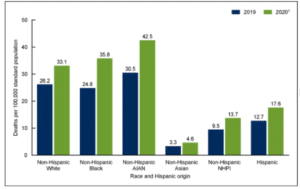
AIAN: American Indian or Alaska Native. NHPI: Native Hawaiian or Other Pacific Islander.
SOURCE: National Center for Health Statistics, National Vital Statistics System, Mortality.
Document 5 LV1 anglais: Political editorial cartoon, Joe Heller, October 2021
1 – COMPRÉHENSION : RÉSUMÉ ANALYTIQUE COMPARATIF LV1 ANGLAIS
Répondre en langue cible à la question posée en 350 mots (+ ou – 10%) en identifiant et en comparant les informations pertinentes dans les documents 1 et 2, sans commentaire personnel ni paraphrase.
According to the authors of documents 1 and 2, how have recent drug-related scandals affected public opinion and policies with regard to the pharmaceutical industry?
II – EXPRESSION PERSONNELLE: ESSAI ARGUMENTÉ LV1 ANGLAIS
Répondre en langue cible à la question posée en 500 mots (+ ou – 10%), en réagissant au contenu du dossier, sans paraphraser celui-ci, tout en développant son opinion personnelle. Vous devez illustrer votre argumentation avec des exemples culturels, civilisationnels et/ou historiques du monde anglophone.
In your opinion, have the opioid crisis and the power of pharmaceutical companies challenged the concept of the American Dream?
III – TRADUCTION DU FRANÇAIS EN ANGLAIS (THÈME LV1 ANGLAIS)
Traduire uniquement la partie du document 3 indiquée entre crochets […………]
Traduire du français en anglais de « C’est une famille d’immigrés.. » à « de pouvoir et d’appât du gain. »
Tu peux lire le rapport du jury sur cette épreuve pour avoir des tips et des insight !
L’analyse sera disponible dans cet article.
On espère que cette épreuve d’anglais LV1 (LVA) ELVi s’est bien passée ! Sache que tu peux retrouver toute l’actualité du concours BCE 2024 sur notre rubrique Inside Concours BCE 2024.
Accéder à toutes nos ressources en anglais